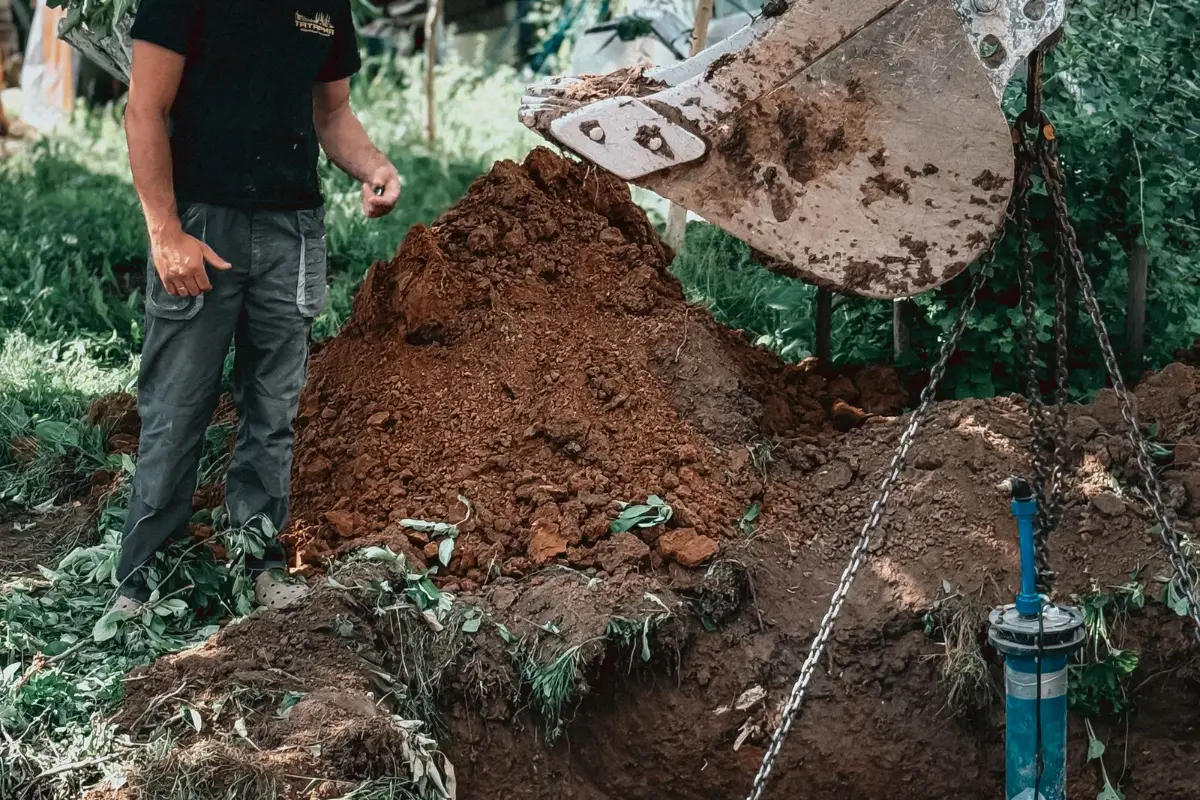
Digging out around a buried riser. Most septic work on the Cape starts with an open trench like this.
Washed stone bedded around leach field pipe lets effluent spread out and soak into sand below.
A loader working a spoil pile. Replacing a whole system moves a lot of soil in and out of the yard.
Where to start
The inspection came back as a fail or a conditional pass
A conditional pass usually means one component, often the tank or the distribution box. A fail starts a two-year clock, and a contractor can tell you within a visit whether a repair or a new system is the answer.
The seller normally orders the inspection, the report is good for two years, and a fail does not stop the sale if the parties plan for it. Book the inspection when you decide to list, not when you accept an offer.
The system needs replacing or repairing, sale or no sale
Slow drains, a wet patch over the field, a pump alarm, or a cesspool on the as-built. A conventional replacement runs about $20,000 to $40,000 here, and two public programs cover a large share of it.
Every part a Title 5 report names, and where it sits in your yard.
Why almost every septic project here starts with a Title 5 report
Massachusetts requires a septic inspection at or within two years before a transfer of title under 310 CMR 15.301, and the buyer must be given the full report. Most houses on Cape Cod and the South Shore sit on septic, so the decision to list turns a system nobody thought about into a dated deadline with a price attached.
The inspection settles one narrow question: whether the system meets any of the failure criteria in 310 CMR 15.303 on the day it is looked at. An approved System Inspector opens the tank and the distribution box, probes the leaching area, measures distances to wells and wetlands, and files the result with the board of health within 30 days.
A sale is not the only trigger. Any increase in design flow calls for one too, an added bedroom included, since flow is set at 110 gallons per day per bedroom. Refinancing and adding a spouse to the deed are not transfers at all; the inspection tool sorts the cases.
Four findings, four different next moves
The official MassDEP form ends in one of four boxes, and each points somewhere different: a pass that lasts two years, a conditional pass waiting on one repair, a referral back to the board of health, or a failure with a deadline. Read the box before any price, because it decides what you may do next.
Passes, and what a pass does not promise
None of the failure criteria was present on the day. The report covers any transfer inside two years, or three with records showing annual pumping. It is a snapshot, not a warranty, and any criterion the inspector could not evaluate has to be listed on the official form for the buyer to see.
Conditionally passes, on one named component
The system passes once a named repair is finished: a metal tank over 20 years old or any unsound tank, a dead pump or alarm, a backup or high level in the distribution box from a broken or settled pipe, or pumping more than four times a year for the same reason. Leaching areas and cesspools cannot be conditionally passed. A septic tank replacement is often the entire fix.
Further evaluation, decided by the board of health
The system sits close to water, and the board of health rather than the inspector makes the call. The triggers are a cesspool within 50 feet of surface water or a wetland, and a leaching area within 100 feet of a surface water supply, in Zone I of a public well, or within 50 feet of a private well. Ask the health office how long a decision takes.
Fails, and the deadline that comes with it
An upgrade is required within two years of the inspection date under 310 CMR 15.305, sooner where the board finds an imminent health threat, and the clock does not restart when the house changes hands. The criteria include sewage backing up indoors, effluent surfacing in the yard, a cracked or unapproved metal tank, and a leaching area below high groundwater. The Title 5 guide takes each finding apart.
Replacement prices in 2026, and the site conditions behind them
A conventional Title 5 replacement for a three-bedroom house is quoted at $20,000 to $30,000 in Massachusetts and a four-bedroom at $25,000 to $40,000; one Cape raised-bed system built over high groundwater came to about $42,000 (CheckMySeptic and Pavel Buys Houses, both secondary).
A nitrogen-reducing system costs more and keeps costing. MassDEP’s June 2023 FAQ put installations at $17,000 to $36,000, Falmouth discussion in March 2025 at about $35,000 (Falmouth Enterprise, secondary), and Eastham in September 2026 at about $40,000 (Provincetown Independent, secondary), with operation and sampling adding $500 to $1,500 a year.
What moves the number most is water: Cape sands that percolate at 2 minutes per inch or faster need five feet between the bottom of the stone and high groundwater under 310 CMR 15.212, so a low coastal lot needs imported sand, a raised bed and a pump chamber. The replacement cost guide itemises the bill.
Two programs, one county line: what the money does
The state gives back 60% of up to $30,000 spent repairing or replacing a failed system at a principal residence, capped at $18,000 in total and $4,000 a year with a five-year carryforward, for tax years from 2023, per mass.gov. Design, engineering, soil testing and construction count; landscaping restoration and voluntary work do not.
In the 15 Barnstable County towns the Cape Cod AquiFund lends at 4% for septic repairs, replacements, cesspool upgrades and I/A installations, 5% where the home is a rental, seasonal, a condominium or expected to be listed within 12 months, and 0% or 2% for income-qualified owner-occupants connecting to new sewer. Terms run up to 20 years, repaid as a betterment on the tax bill.
AquiFund stops at the Barnstable County line, and nothing county-wide replaces it. South Shore owners use what their own town runs: the Town of Plymouth lends at 5% over 5, 10 or 15 years against a documented failure (Plymouth Redevelopment Authority), Kingston borrows through the Old Colony Planning Council, and MassHousing lends up to $25,000 statewide. Program terms are set by the agencies and change; confirm with the state or county page linked here. The tax credit guide and the AquiFund guide cover the paperwork.
Every Cape town filed by July 2025, so the I/A clock never started
MassDEP’s nitrogen amendments took effect on July 7, 2023 and designated 30 Cape Cod watersheds as Natural Resource Area Nitrogen Sensitive Areas, with Wellfleet Harbor added afterwards for 31. About 86,000 systems sit inside them (Cape Cod Commission), facing a five-year deadline to upgrade to Best Available Nitrogen Reducing Technology, but only where the town let the two-year filing window pass.
None did. By the close of that window on July 7, 2025, every Barnstable County town with a designated area had filed a notice of intent, a watershed permit application or a de minimis application, per MassDEP’s application table; Provincetown has no designated area at all, sewered from 2003 onward. The five-year clock is therefore not running anywhere on the Cape, and a failed system in a designated watershed can still be replaced with a conventional one under state rules in 2026. Confirm that with the board of health first.
Towns may go further on their own account. Falmouth’s regulation FHR 15.15, in force since November 15, 2025, requires a nitrogen-reducing system at 10 mg/L or less for new construction, a raze-and-rebuild, an added bedroom or any increase in flow in its nitrogen-regulated areas (Falmouth); Eastham paused proposed cesspool rules in September 2026. The nitrogen rules guide lists the watersheds town by town.
What a septic request can be, from a pump-out to an I/A system
Scale does not change the paperwork: replacing a single component, a distribution box included, still needs a Disposal System Construction Permit and a Certificate of Compliance under 310 CMR 15.020.
Fifteen towns on the Cape, eight on the South Shore
This site covers all 15 Barnstable County towns, from Provincetown at the tip to Bourne at the canal, and eight in Plymouth County: Plymouth, Wareham, Kingston, Carver, Duxbury, Marshfield, Pembroke and Middleborough. Title 5 itself reads the same on both sides of the bridge. The nitrogen designation, the county loan and the local add-ons do not.
Barnstable County towns sit inside the designated watersheds, have AquiFund, and belong to the Cape Cod and Islands Water Protection Fund, a 2.75% lodging excise that subsidises municipal wastewater borrowing and holds down what towns recover through betterments (Cape Cod Commission). Barnstable caps its residential sewer assessment at $10,000 per unit. No Plymouth County watershed was automatically designated in 2023.
Local rules run the other way. Duxbury requires a Title 5 inspection for any addition over 50 square feet whether or not it adds flow, and reads observation well #79 for a high-groundwater adjustment. Each town page names the health office, the permit route and the money that applies there, and the full list sits on the service areas page.
Who writes this site and how it makes money
Cape Cod Septic Experts publishes plain guides to Title 5, the nitrogen rules and the money programs, and connects homeowners with independent local septic companies that can price the work. The about page has more.
Three steps from your form to a written quote
1
Tell us about the property
The town, what is happening with the system, where you are in a sale if there is one, and how to reach you. One short form, no fee.
2
A local septic company calls you
A septic contractor who works in your town phones you to ask a few questions and arrange a visit to the property.
3
A written quote after the visit
The contractor walks the lot, pulls the as-built if there is one, and gives you a written scope and price. There is no obligation; compare it and decide on your own schedule.
Money
Help paying for septic work
Two public programs pay for a large share of most Title 5 upgrades. Which one applies depends on the county the house is in.
Statewide, principal residence
State income tax credit for Title 5 work
60% of qualifying repair or replacement costs, on up to $30,000 of expenses
Up to $18,000 in total credit per household, taken at up to $4,000 a year
Unused credit carries forward for up to 5 years
Applies to the home you live in, not a rental or second home
Program terms are set by the agencies and change; confirm with the state or county page linked here before you count on a number.
Licensing
Check the credentials before you sign
Massachusetts has no single statewide septic contractor license. Two separate approvals matter. A Title 5 inspection is valid only when a System Inspector approved by MassDEP performs it. Installation and repair work is permitted town by town: each board of health licenses installers and issues the Disposal System Construction Permit for the job.
You can check both yourself. The state publishes the inspector training and approval program, and the regulation itself sets out who may do what.
Which of you holds the Title 5 System Inspector approval, and can I see the certificate?
Only a MassDEP-approved System Inspector may sign an official inspection form. The approval is personal to the inspector, not to the company.
2
Are you on this town’s current list of approved septic installers?
Installation licenses are issued by each board of health, one town at a time. A crew licensed in Falmouth is not automatically licensed in Bourne.
3
Who pulls the permit, and will I get the as-built plan and the Certificate of Compliance?
The permit and the final sign-off are what a future buyer’s inspector will ask for. Get it in writing that both come to you when the work closes out.
Questions homeowners ask
What does it cost to use this site?
Nothing. Most local companies offer free estimates, and there is no obligation. You deal with the septic company directly, get their written estimate, and can decline it.
Do you send my request to more than one contractor?
No. Your request goes to one septic company that works in your town, not to a list, and you will not get a string of sales calls. You are always free to get other bids on your own.
Which towns do you cover?
All 15 towns in Barnstable County: Barnstable, Bourne, Brewster, Chatham, Dennis, Eastham, Falmouth, Harwich, Mashpee, Orleans, Provincetown, Sandwich, Truro, Wellfleet and Yarmouth. And eight in Plymouth County: Plymouth, Wareham, Kingston, Carver, Duxbury, Marshfield, Pembroke and Middleborough. Each town has its own page covering the health office, local rules and money programs, all listed on the service areas page.
Are you a septic company?
No. Cape Cod Septic Experts connects homeowners with independent local septic companies, which do the work under their own permits and contract with you directly. Our part is the research on these pages and the introduction to one company that works in your town.
How do I check that the contractor is licensed?
Two ways. An installer must hold a Disposal System Installer's permit from your town's board of health, and most towns post the current list online or will confirm by phone. A Title 5 inspector must be MassDEP-approved; ask for the approval number and check it against the NEIWPCC listings, which are updated regularly. We ask every contractor we refer to for both before we send a single request.
Can I use the site for a pump-out or an inspection only, not a replacement?
Yes. Requests for septic pumping, a Title 5 inspection, a pump or alarm repair, a distribution box or a tank swap are all covered, and small jobs are quoted as readily as full systems. Say what you need on the form. If the visit turns up something larger, you get a written scope before anyone digs.
Tell us about your system
One call or form, a written quote after a site visit. Free for homeowners, no obligation.